
How to Search Criminal Dockets
Minnesota Court Records Online, or MCRO, is where a Winona County criminal docket search starts. It covers cases, hearings, judgments, and public documents across the state. When you know the category, pick Criminal. Choose Winona as the court location. Then open the matching case to reach its register of Actions. That register is the chronological docket, not a certified case file.
The best identifier is a complete case or citation number. A name, attorney, or citation also works. Before you rely on a result, check the filing date. Check the Winona County District Court location too. Also compare the case category and the current setting against each other. If the portal and a notice disagree, Court Administration can confirm the local criminal setting.
- Open MCRO Case Search and choose the narrowest search method available.
- Select Criminal and the Winona County court location when those filters fit the known case.
- Enter a complete case number, citation number, attorney, or name, then review the matching case details.
- Read the Register of Actions, settings, charge information, and public document links without treating a charge as an outcome.
- Use Winona County District Court Administration for a certified copy, a courthouse search, or date confirmation.
Winona Criminal Docket Search Choices
MCRO's case form gives you Name, Case Number, Citation Number, and Attorney searches. Name search lets you set last, first, and middle names. You also get a Sounds Like option, filing-date and date-of-birth filters, and a county selector. A full Minnesota number goes in with or without dashes or leading zeroes. Never use spaces. Winona is county code 85, so a notice may show a pattern like 85-CR-YY-NNNN. Use the actual number printed on the notice rather than guessing at one.
The MCRO Case Search form lays out the public controls. Use them to narrow a Winona criminal docket search.
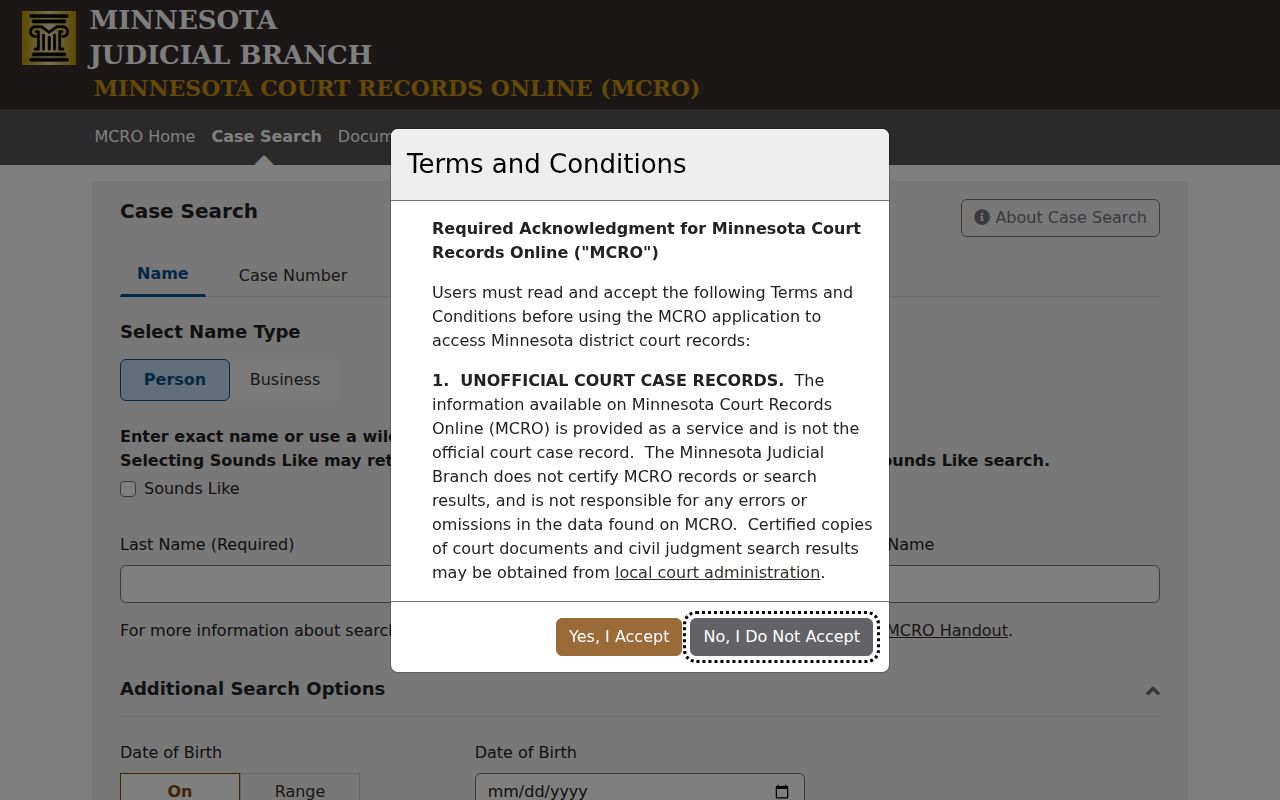
The form splits the case lookup from the later Register of Actions review. That separation keeps a criminal record search tied to the correct court file.
Winona Criminal Docket Name Limits
Name searches can miss a record. Names vary. An initial may have been used instead. Or a case may sit outside remote access. Run separate searches: the name without a middle name, then with a middle initial, then with Sounds Like. After two characters you can add a trailing wildcard, though not together with Sounds Like.
Defendant-name searches also leave out pending criminal, traffic, and petty-misdemeanor cases that lack a conviction. That does not mean the court has no case. The right next step might be a known case number. It could also be a citation number, an attorney search, the courthouse MNPAC terminal, or a call to Winona Court Administration.
Note: MCRO is a court reference tool. Its own official materials warn against using name results as a background check.
What a Criminal Docket Shows
A Winona County criminal Register of Actions can list the case number, filing date, court location, assigned judicial officer, case status, party and attorney fields, charges, chronological events, hearings, documents, and disposition information. Public financial or bond information appears on some case pages too. What you see depends on the file itself and on remote-access limits.
| Case Number | County, case-type, year, and sequence, such as an illustrative 85-CR-YY-NNNN pattern. |
|---|---|
| Charge Block | Public offense description, statute, and classification when shown; it does not itself prove a conviction. |
| Register Entries | Chronological filings, orders, hearings, plea events, review events, and other court actions. |
| Hearing Settings | Date, time, location or remote session, hearing type, judicial officer, and participant connection type. |
| Disposition | A public dismissal, plea resolution, conviction, acquittal, sentencing, or other recorded result when one has been entered. |
Document links, when present, are not the same as docket entries, and a downloadable public document is never a certified copy.
Winona Criminal Docket Charge Blocks
A charge block may name an offense, a statute, and a classification. Felony, gross misdemeanor, misdemeanor, and petty misdemeanor are terms defined by Minnesota law. Still, the court's own charge text controls the record. Do not rewrite a charge or read a final result out of its severity.
A filing, a pending count, and a conviction are three different things. Later, the public register may show a plea, a dismissal, a trial result, a sentence, or another disposition. When an entry's meaning is unclear, trust the written event text and consult the court record instead of inventing a meaning for a short code.
Stages on a Criminal Docket
A Winona County criminal case can begin with a complaint. It can also begin with a citation or another charging document. From there it may move through first appearance, arraignment, omnibus work, pretrial activity, a plea or trial, disposition, and sentencing. Later entries can cover probation review or violation proceedings. They may also list contested revocation, resentencing, or a notice of appeal. Each stage can produce both a docket entry and a hearing setting.
Docket flow: Charging Document › First Appearance › Arraignment › Omnibus or Pretrial › Plea or Trial › Disposition › Sentencing
Authorized users can make later eligible filings through Minnesota eFile and eServe. Its official rules say charging documents are not filed through eFS. And remember, eFS handles filing and service, not public criminal docket search.
Winona Criminal Docket Omnibus Settings
The Winona daily District Court Calendar separates an Omnibus Hearing from a Contested Omnibus. It also lists a Default Omnibus. An omnibus setting deals with pretrial issues, including evidentiary or constitutional matters. The calendar's labels describe the type of court event, not the outcome of the case.
Rows on the calendar also list a hearing location, time, judicial officer, and connection type. Court Room 1 and Court Room 2 are examples of local locations. So are Zoom Session and DW-Zoom Session on the generated report. If a calendar row differs, the case-specific notice controls.
Winona Criminal Docket Trial Preparation
Late in a Winona criminal case, the docket can pick up entries tied to the amended scheduling order. That order sets firm deadlines. It asks Court Administration for 30 days' notice of interpreter or witness needs before trial. Motions in limine, witness and exhibit lists, and jury instructions come due seven days before trial.
Proposed electronic, photo, and media exhibits go to MNDES by the end of pretrial. Plaintiff exhibits draw numbers 001 through 099. Defendant exhibits run 100 through 199. Keep in mind these are trial-management instructions. They are not abbreviations you will decode in a public Register of Actions entry.
Which Court Holds Criminal Dockets
Every criminal case filed here lands in one place. That place is the Minnesota District Court, Winona County District Court, a unified trial court inside the Third Judicial District. Its criminal docket spans felonies, gross misdemeanors, misdemeanors, petty misdemeanors, criminal-traffic matters, probation, revocation, and related proceedings. The structure names no separate felony clerk or misdemeanor clerk. Winona County District Court Administration maintains the court record. It can also route the record to the right office.
A city may run its own administrative citation path. But a filed state criminal case never moves to a separate Winona municipal or justice-of-the-peace portal. If an appeal follows, it becomes its own record inside the Minnesota Court of Appeals system. That record sits apart from the trial court docket.
Winona Criminal Docket Treatment Court
Winona Treatment Court opened in 2012 for participants facing chemical-dependency or mental-health needs. The county program runs alongside probation and regular court. It is not, however, a public treatment file. MCRO can display public court events. Protected treatment, participant, and health information stays out of the criminal docket the public sees. Winona County’s Treatment Court information describes the program and lists its public contact details.
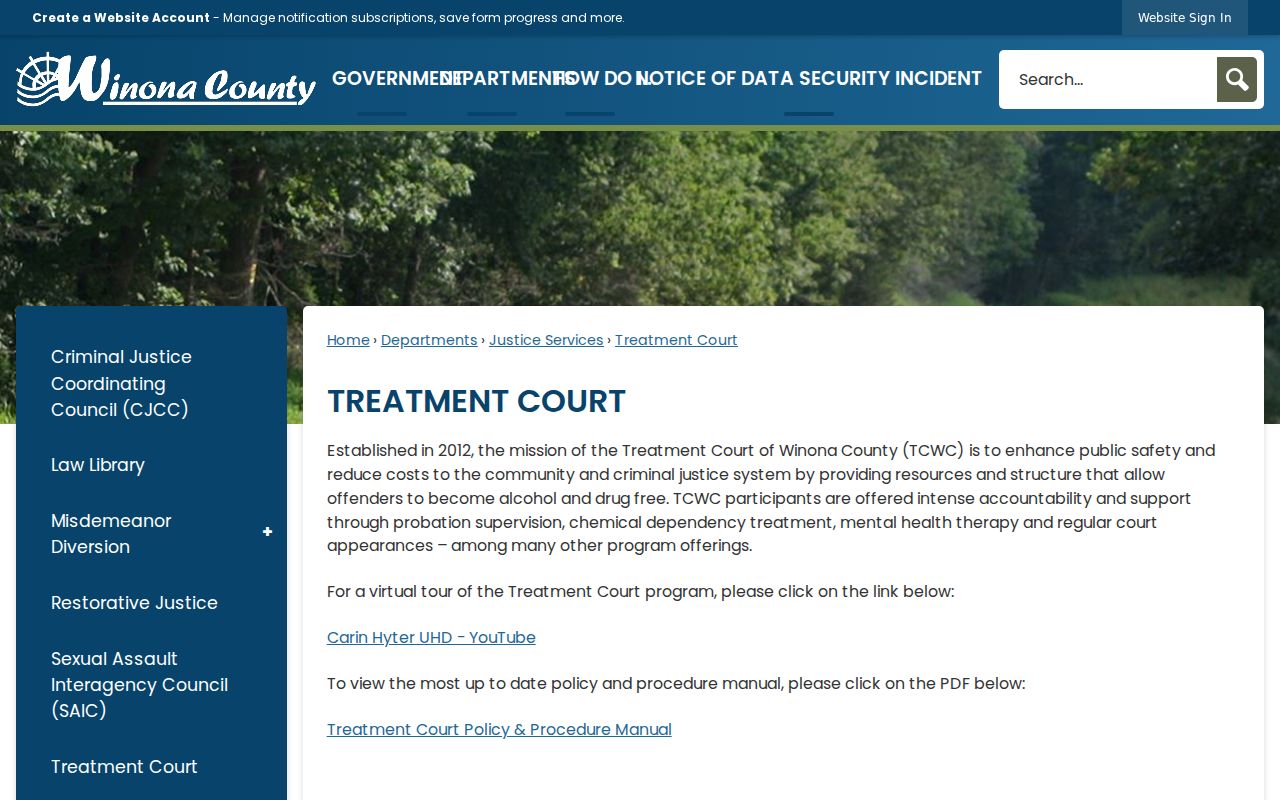
Winona Policy 525 governs how hearings are held. It puts Treatment Court hearings in person, even when another criminal hearing category defaults to remote.
Public Access and Sealed Criminal Dockets
Access to Winona County court files has one framework. That framework is the Minnesota Rules of Public Access to Records of the Judicial Branch. Rule 8 does most of the work. It lets you inspect and copy public records where they are normally kept. Remote access covers calendars and indexes. It also covers Registers of Actions, judgment dockets, certain court-prepared records, and approved public documents. Even so, not every criminal detail becomes available from home.
Key Rules:
Minnesota Rule of Public Access, Rule 8 permits public court-record inspection while limiting remote access to protected information and certain case types.
Minnesota Rule of Public Access, Rule 7 allows an oral or written request that identifies the record without requiring a reason.
Minn. Stat. § 609A.01 describes expungement policy and the limits on ordinary disclosure of sealed records.
Extra limits apply to juvenile matters, expunged files, protected identifying data, and some preconviction name-search results. Minnesota's Chapter 13 public-data statute sits beside this system. It does not replace the Judicial Branch Rule 8 route for a court file.
Winona Criminal Docket MNPAC Fallback
When an older criminal record or public document is missing from MCRO, turn to the Minnesota Public Access Courthouse terminal, known as MNPAC. Or ask Court Administration which public route fits. MNPAC is the deeper public electronic layer. There is no remote login, so you use it at the courthouse. It can surface public material that the web search does not reach.
Find Winona Court Administration at 171 W. Third Street, Winona, Minnesota 55987, or call 507-615-5183. Court hours run Monday through Friday, 8:00 a.m. to 4:30 p.m. Check the official Wednesday-hours note before you visit. Rule 8 allows local inspection of public records where they are normally kept. That access runs during regular hours.
Copy requests can go through the local counter. Mail, in-person delivery, eFiling, and an eFS copy-request channel also work where appropriate. Name the case number, the document, and the copy type you want. A plain copy is currently listed at $0. Certified copies generally cost $14. Certified-plus-exemplified copies cost $28.
If a criminal result is restricted, Court Administration can explain the access rule that applies. It cannot turn a sealed record into a public one.
Winona Criminal Docket Appeal Records
A notice of appeal may show up in a Winona trial Register of Actions. That entry does not turn MCRO into the appellate docket. The Minnesota Court of Appeals holds the intermediate appellate record. Its public P-MACS search is the right layer. Use it once an appeal is filed. Remember one thing. A trial-case number and an appellate-case number are separate identifiers.
So lean on the trial docket for Winona District Court history. Use the appellate search for the appeal itself. The split matters most in one situation. That is when a criminal case carries both a local disposition and later appellate activity.